

Looking For Something? Search Our Site Here!


 After their wedding in 2022, Katie and Cru Cavage wasted no time trying to start a family together.
“We were both older – I was 36 – and we knew that it might be wise to be proactive, so we reached out to Texas Fertility Center and got started with them right away,” Katie explains. “We had shopped around and decided on TFC after we read lot of good reviews about them, and specifically about Dr. Silverberg. We found an article from the 90s that he had written, so we knew he’d been doing this forever. People come from all over world to see him, and we live in Austin, so we felt so lucky that he is here.”
Dr. Silverberg’s first step was a comprehensive fertility evaluation, with testing for both Katie and Cru.
 “We found out that my husband’s fertility was pretty good for his age, but mine was way below average,” Katie says. “I was at .2 for AMH, so it was almost slim-to-none odds that it would happen naturally. My diagnosis was diminished ovarian reserve, and I had some polyps in my uterus, which Dr. Silverberg removed with hysteroscopy. But Dr Silverberg is a straight shooter and an optimist, and he told us, ‘We are going to get you pregnant.’ We put a lot of faith in that.”
Dr. Silverberg recommended IVF as the fastest and most effective path to parenthood for Katie and Cru. Their first round of IVF resulted in four embryos, which was a good outcome, especially considering the diagnosis of diminished ovarian reserve. The couple chose to have their embryos tested with PGT-A, or preimplantation genetic testing for aneuploidy. The genetic tests determined that two of the embryos were chromosomally normal, and one of those two was selected for transfer.
While that embryo transfer led to the excitement of a positive pregnancy test, an early miscarriage brought a sad end to the first phase of the Cavages’ IVF journey. But they, and Dr. Silverberg, quickly made a plan to keep moving forward.
 “We only had one embryo left, and at this point, it had been a year of fertility treatment,” Katie says. Knowing that they might want more than one child, they had hoped for additional embryos to store, and they knew that a diagnosis of diminished ovarian reserve meant that their chances would only get lower over time. “So, we did a second round of IVF.”
The Cavages’ second IVF cycle produced four chromosomally normal embryos. With a total of five good-quality embryos safely cryopreserved, they began to prepare for a second embryo transfer. But this time, it took three months of tweaking medications to get Katie’s uterine lining ideally prepared for the embryo to implant.
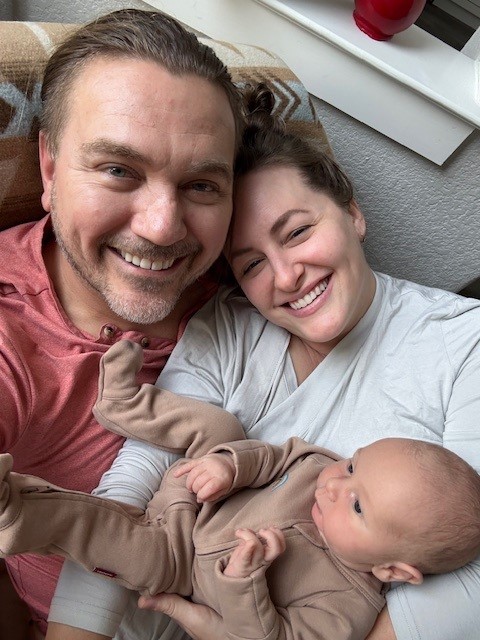 Finally, in June 2024, everything was ready to go. The second embryo transfer was a success, and in February 2025, their son, Cade, was born.
“He is the sweetest thing ever, and he’s so perfect,” says Katie, who was 39 when the delighted couple finally got to hold their baby for the first time. “It’s been quite the journey, and we are just so excited to be here now. For a long time, I didn’t think it was going to happen, so this is the biggest dream come true, and that makes it even sweeter. Now we have four embryos left in total – two boys and two girls. If we decide to try again, we will try for a girl next time.”
Graduating from TFC in Austin to the care of their local obstetrician was bittersweet for Katie and Cru. “Dr. Silverberg is amazing, and he’s my favorite doctor ever,” Katie says. “We are very happy with how everything went. I cried when we graduated because I was so sad to leave him and the TFC team.”

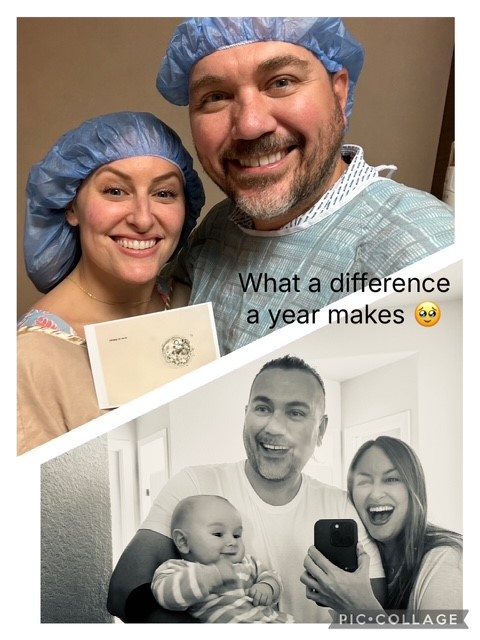 The Cavages were open with others about their diagnosis of diminished ovarian reserve, and talked about their fertility struggles and treatment with family and friends. This not only helped them get through the lengthy and emotional process, but inspired three other couples to start fertility treatment, too.
Fertility treatment feels like being in limbo, and it’s not easy, Katie says. But, she advises others who are struggling to conceive to put their faith in science, like she and Cru did.
“We started at the end of 2022 and had our son at the start of 2025,” she says. “It was a two-year roller coaster, and it’s not linear – you think you are on the right track, only to have a major setback. But people need to know, that’s how it is supposed to be. It’s all happening organically, and it’s normal if things are touch and go, so don’t be worried. It’s all tailored to you and how your body is responding. You have to have faith that it can happen, and that it will. It works!”