


Looking For Something? Search Our Site Here!



Shortly after moving from New Orleans and settling down in Texas, Allison French and her husband, Sam, decided it was time to start a family. Two years later, they still hadn’t seen a positive pregnancy test. It was time to find out why, so they started looking for a fertility specialist in the Austin area.
“We read a lot of Google reviews and patient stories, and we felt confident that Texas Fertility Center was a nice clinic to be part of,” Allison says. “We went into it open-minded, hoping to get general information about whether there was something we didn’t know about that was causing this.”
The couple met with Allison Petrini, MD, a TFC reproductive endocrinologist who sees patients in South Austin. After documenting their medical history, Dr. Petrini ordered a comprehensive fertility evaluation for both Allison and Sam. Nothing in the test results indicated that the couple shouldn’t have been successful.
“We were able to cross a lot of things off the list,” Allison explains. “It wasn’t him, and there was nothing super apparent going on with me. Our diagnosis was ‘unexplained infertility,’ and Dr. Petrini explained our treatment plan: IUI first, then IVF if needed.”
Their insurance covered three IUI attempts before IVF, but unfortunately, all three were unsuccessful. It was time to move on to IVF.
“We went through one cycle and got a lot of eggs, but only five embryos really grew,” Allison says. “We opted for genetic testing, and out of those five, only one was genetically normal. If I had to name a low point in all of this, that was it. You go so long and so far, and we really thought that we’d have a few tries, or that if the first one worked, we’d have a possibility of a sibling. That was when we realized that we could have gone through all this and it might not even work out.”
However, during the treatment process, Dr. Petrini had made an important discovery: Allison’s uterus was abnormally small and heart-shaped, a condition called bicornate uterus. While this condition doesn’t always cause infertility, it can increase the risk of pregnancy complications.

“Dr. Petrini was super helpful and went through all the pros and cons of having surgery to have the uterine septum removed,” Allison says. “We opted to go through the surgery, which set us back by a month. And it was worth it because that one embryo implanted and stuck, and I had a very normal pregnancy.”
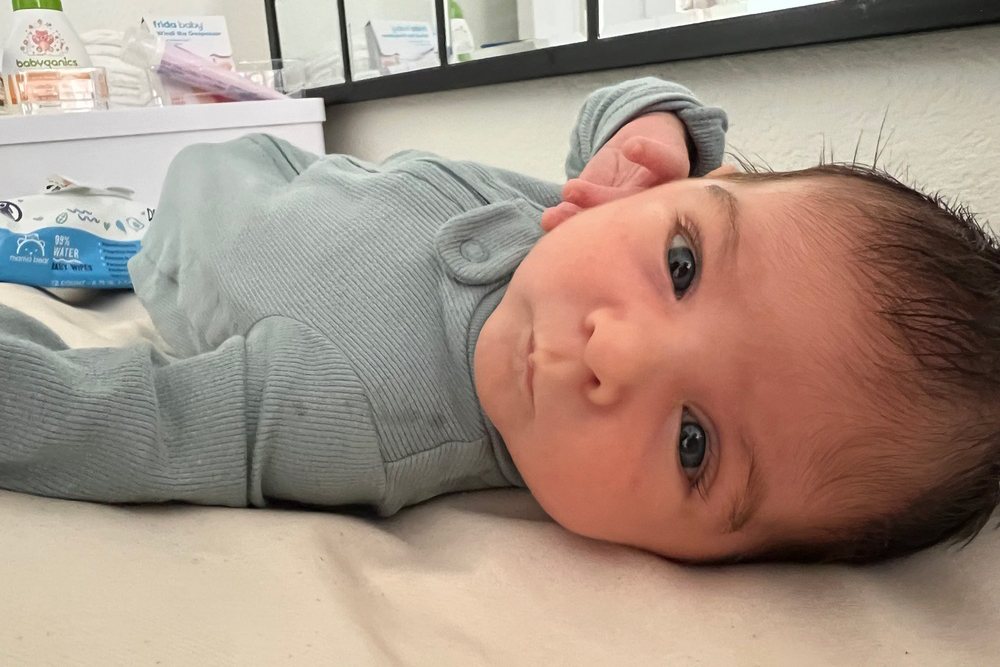
The couple’s son, Noah, was born in August 2025, on Sam’s birthday.
While getting to know their newborn son in his early weeks of life, the couple was already talking about trying for a second child in the future.
“We are going to give it a shot again naturally, but if we aren’t successful, there is no doubt where we’re going to go to try again,” Allison says. “If anyone I knew were going through something similar, we would 100% recommend Texas Fertility Center. We had such a good experience. We loved Dr. Petrini. She is very rational and always explained things really well. We never felt like we couldn’t ask questions. She was open, warm and really knowledgeable, and we always felt comfortable in her care.”

The couple was also impressed with the nursing staff and TFC South Austin support team, who were consistently kind, sensitive and communicative.
“They stay on top of what’s going on with you, so that when they are interacting with you, they are not guessing about what’s in your file, and they don’t say the wrong thing or make you explain where you are, which can be hard to talk about,” Allison says. “They always knew what was going on with me, personally, as a patient. I felt very supported and understood.”
Allison feels for other couples struggling with unexplained infertility, and encourages them to stay open minded. “Infertility in general can be confusing because it’s all new to most people,” she says. “It’s stressful to have to keep playing that mental game, but you can’t put blame on yourself. It’s not a ‘fault’ situation, and thankfully, there is science and ways around it. Keep a balanced mindset, and if one thing doesn’t work, try another.”